
25% OF WHAT EXACTLY? THE MATH BEHIND YOUR MUSIC ROYALTIES.
Most artists focus on one number in a music deal: their royalty percentage.
25%. 30%. Sometimes even 50%.
But there’s a more important question most people never ask: 25% of what exactly?
Because in music contracts, that percentage can be calculated on two completely different figures and the difference between them can cost you millions.
The Two Numbers in Every Music Deal
Every time your music generates revenue, contracts typically calculate your earnings in one of two ways: Gross Revenue OR Net Profit.
The royalty percentage you receive is calculated on one of these two figures, and the one used in your contract determines what you actually get paid.
Gross Revenue
Gross revenue is the total amount generated from your music before any expenses are deducted. It usually includes:
- Streaming revenue
- Music sales
- Licensing and sync fees
- Performance income
Think of it as the whole cake before anyone cuts a slice.
If your contract gives you 25% of gross revenue, your royalty is calculated from the full amount earned before any deductions are made.
Net Profit
Net profit is what the amount remaining after expenses are deducted from the gross revenue (total revenue). These deductions often include:
- Recording and production costs
- Marketing and promotional spend
- Distribution fees
- Video production costs
- Advances already paid to you
- Administrative and legal fees
What’s left after all deductions is the “net.”
If your deal is 25% of net profit, your royalty is calculated from the amount left only after these costs have been removed.
The Mathematical Difference
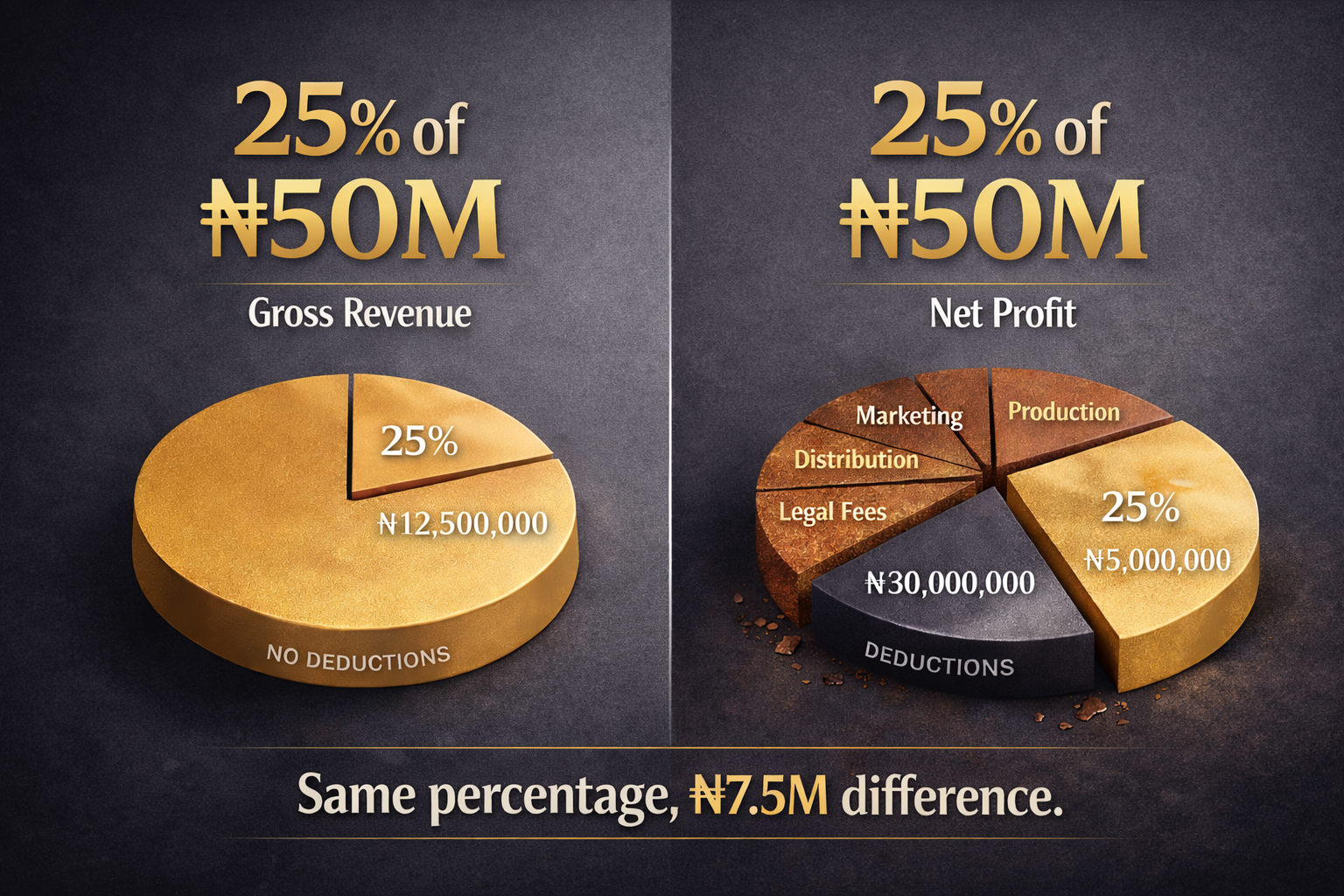
Let's say your song generates ₦50,000,000 and the total deductions amount to ₦30,000,000.
That leaves:
- Gross Revenue: ₦50,000,000
- Net Profit: Gross Revenue - Deductions = ₦20,000,000
Now apply your royalty:
- 25% of Gross = ₦12,500,000
- 25% of Net = ₦5,000,000
Same percentage. Same song. But a ₦7,500,000 difference.
In many agreements, royalties are calculated on net profit rather than gross revenue because labels and distributors need to recover the money invested in recording, marketing, promoting, and distributing the music.
The issue is not that deductions exist as releasing music costs money. The real issue is when contracts do not clearly define what counts as a deductible cost.
In many agreements, deductions are vaguely described or not listed at all. Which means the label decides what gets deducted. And when that happens, the list can expand in ways you didn’t anticipate.
The One Question You Must Ask
Whether your deal is gross or net, before signing any contract, ask:
“What exactly is defined as a deductible expense in this contract?”
Because a well-drafted contract should:
- Clearly list all permitted deductions
- Limit what can be charged
- Prevent open-ended cost recovery
That clarity is what protects you not the percentage alone.
Music is creative. But it is also a business.
Understanding how your revenue is calculated matters just as much as the royalty percentage itself.
Know your number.
Know what it is calculated on.
Know what gets deducted first.